Open-source Maps Should Help Driverless Cars Navigate Our Cities More Safely Mit Review
Our current street maps aren't much skilful for helping driverless cars get around. Although nosotros've mapped most roads, they go updated merely every couple of years. And these maps don't log any roadside infrastructure such every bit road signs, driveways, and lane markings. Without this actress layer of data, it volition be much harder to get democratic cars to navigate our cities safely. Robotic deliveries, as well, will eventually crave precise details of road surfaces, sidewalks, and obstacles.
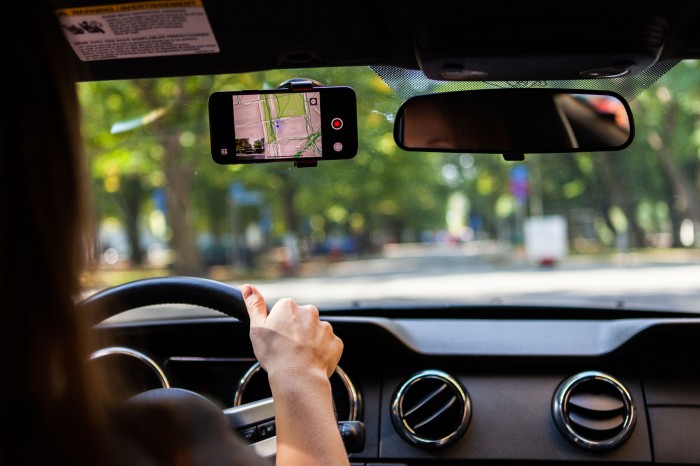
A Swedish startup called Mapillary thinks it has the answer. Information technology's an open platform that crowdsources images of streets taken past people on their smartphones: a sort of Wikipedia of mapping. It says it is now one of the biggest publicly available databases of street-level imagery in the globe.
"Driverless cars need the latest view of the road," says CEO Jan Erik Solem. "They require a higher and higher update frequency for maps, from quarterly to monthly to weekly to daily. The simply scalable way to do that is using technology."
There are a number of approaches to gathering mapping information, and there'southward competition amidst startups within the field. Mapillary says it is different because it is crowdsourced—unlike, say, Google's proprietary Street View, which is updated every couple of years. Because anyone can contribute to its platform, information technology gets updated every day.
Mapillary
This approach is similar to OpenStreetMap, which launched in 2004 and provides a free, editable map of the world, but it doesn't log any of these additional roadside details.
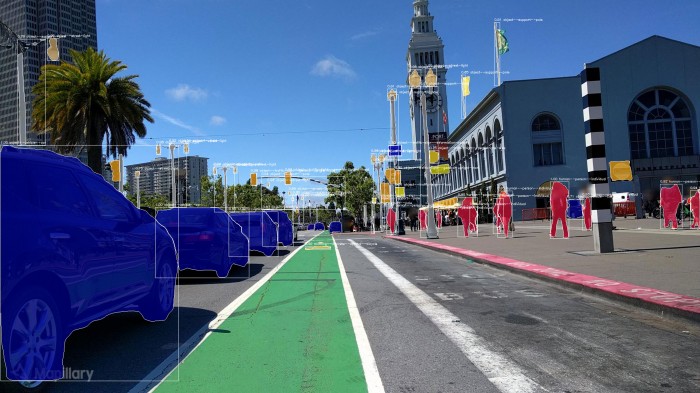
Mapillary uses figurer-vision software to analyze the crowdsourced images and identify objects. Its database of 422 one thousand thousand images covers half dozen.two million kilometers (three.nine million miles) of the world. And information technology'south growing all the time: its software has just put 186 million objects, like utility poles, benches, and manhole covers, on the map, locked to a specific location with coordinates.
Once the images are uploaded, the software analyzes them for objects and identifies them. The maps are then fabricated available for anyone to see online. The service is costless for charities and for educational or personal use, but commercial customers take to pay a license fee.
Mapillary is already beingness put to use. The city of Amsterdam, transport officials in Vermont and Arizona, and fifty-fifty the country of Lithuania are using the firm's maps to improve their understanding of their streets.
"If you lot look at any object on a street, someone is responsible for it. It all has to be catalogued and checked," says Steven Hewett, who works for the city of Clovis in New United mexican states.
Mapillary
Clovis is using Mapillary to make sure it'southward fulfilling its obligations to residents by keeping driveways articulate, signs up to engagement, and roads clear of potholes. The urban center used to do this by paying a contractor to go around and painstakingly log every mailbox, fire hydrant, and finish sign, for a few dollars each.
It has now automated nigh the entire procedure using Mapillary. "Without this software, we'd be walking around collecting all the data by hand, and I can't fifty-fifty approximate how long that'd have for a 23-square-mile city," Hewett says.
Gabriel Brostow, a informatics professor at University College London, agrees that this kind of mapping needs to exist automated to exist scalable. "Millions of square kilometers in the world tin can't exist updated past humans equally quickly as they could be past algorithms," he says.
I 24-hour interval, driverless cars could be both consumers and producers of this data, capturing street-level imagery as they travel (both faces and license plates are automatically blurred out by Mapillary'south software). Indeed, Hewett foresees a hereafter where networked vehicles can automatically place problems similar fallen trees in the route, or traffic accidents, and automatically notify the relevant public authorities.
The data could too assist equip cities with better knowledge of their streets so they can meliorate public transport and accessibility for disabled people, Brostow adds.
*This story was corrected to brand clear the images are crowdsourced simply the underlying code is not open source.
Source: https://www.technologyreview.com/2019/01/24/66173/open-source-maps-should-help-driverless-cars-navigate-our-cities-more-safely/
0 Response to "Open-source Maps Should Help Driverless Cars Navigate Our Cities More Safely Mit Review"
Post a Comment